
Equipment Depreciation refers to the loss of value that machinery and equipment experience over time. Factors such as physical wear, technological advancements, and changing market demand can affect equipment value. Understanding Equipment Depreciation helps business owners, lenders, and attorneys make informed decisions about their machinery and equipment assets.
Understanding these factors helps business owners, lenders, and attorneys make informed decisions about valuable equipment. However, depreciation does not affect every machine equally. Some assets retain substantial value for decades, while others lose value much faster.
For additional information about accounting depreciation, the Internal Revenue Service (IRS) provides guidelines on depreciating machinery, equipment, and other business assets in Publication 946.
What Is Equipment Depreciation?
Equipment depreciation describes a reduction in machinery or equipment value caused by physical deterioration, functional limitations, or external economic conditions. In appraisal, depreciation helps explain why an existing asset may be worth less than a comparable new one.
For example, a manufacturing machine may continue operating after ten years of use. However, newer models may offer faster production, improved automation, or lower operating costs.
As a result, the older machine may have a lower value despite remaining functional.
Depreciation also has an accounting meaning. Businesses use accounting depreciation to allocate an asset’s cost over its estimated useful life.
However, accounting depreciation does not necessarily reflect current market value. Therefore, appraisers distinguish between depreciation recorded in financial statements and depreciation considered during equipment valuation.
What Are the Three Types of Equipment Depreciation?
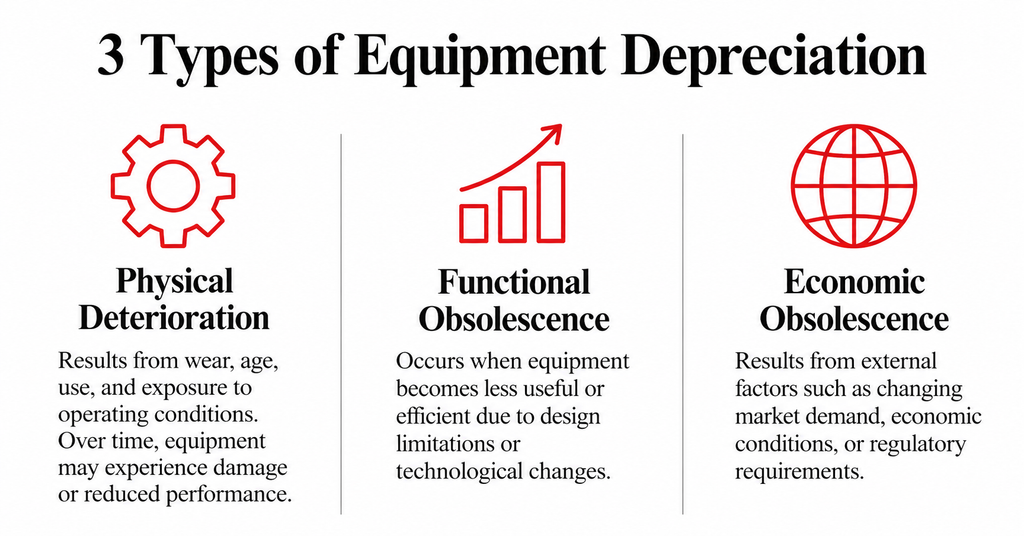
A Machinery Appraiser generally considers three forms of depreciation when applying the cost approach to equipment valuation. Each type represents a different cause of value loss.
Physical Deterioration
Physical deterioration results from wear, age, use, and exposure to operating conditions. Over time, machinery components may experience damage or reduced performance.
For example, an industrial press may require replacement parts after years of heavy use. Consequently, its condition may affect its value.
Regular maintenance and repairs can help preserve equipment performance. However, maintenance does not always eliminate every form of physical deterioration.
Functional Obsolescence
Functional obsolescence occurs when equipment becomes less useful or efficient because of design limitations or technological changes.
For example, an older manufacturing machine may require more labor than a newer automated model. Although the older machine still operates, its higher operating costs may reduce buyer interest.
Therefore, technological improvements can affect machinery value even when its physical condition remains good.
Economic Obsolescence
Economic obsolescence results from external factors that reduce equipment value. These factors may include changing industry demand, economic conditions, or regulatory requirements.
For example, declining demand for a manufactured product may reduce interest in specialized production equipment.
As a result, machinery can lose value even when it remains operational and properly maintained.
How Does an Equipment Appraiser Evaluate Depreciation?
An Equipment Appraiser examines the machinery’s characteristics and relevant market evidence. The goal is to understand how different forms of depreciation influence the asset’s value.
First, the appraiser identifies the equipment and reviews its specifications. Next, the appraiser evaluates its condition, remaining usefulness, and market demand.
Important factors include:
- Equipment age: Older machinery may experience increased wear or technological limitations.
- Physical condition: Damage, repairs, and operating condition can affect value.
- Operating hours: Usage records may provide insight into physical deterioration.
- Manufacturer and model: Equipment specifications can influence buyer demand.
- Technological advancements: Newer machines may offer improved efficiency or capabilities.
- Maintenance history: Regular servicing can help preserve equipment performance.
- Market demand: Industry conditions can influence equipment prices.
- Remaining economic life: The expected period of continued economic usefulness helps inform valuation.
Additionally, the appraiser considers the equipment’s intended use and applicable definition of value.
These factors help develop a supported valuation rather than relying on age alone.
Equipment Depreciation and Book Value
Equipment depreciation affects both accounting records and appraisal analysis. However, book value and market value serve different purposes.
| Term | What It Means |
|---|---|
| Accounting Depreciation | The allocation of an asset’s depreciable cost over its estimated useful life. |
| Book Value | The asset’s recorded cost minus accumulated depreciation and applicable adjustments. |
| Market Value | An estimate of value based on the applicable market conditions and value definition. |
| Appraisal Depreciation | The loss in value attributable to physical deterioration, functional obsolescence, and economic obsolescence. |
For example, a company may have fully depreciated a machine in its accounting records. However, that machine could still operate effectively and attract buyers.
Likewise, equipment with a substantial book value may have limited market demand.
Therefore, accounting records alone may not establish an asset’s current value.
When Does Equipment Depreciation Matter?
Equipment depreciation plays an important role in several business and financial decisions. A professional Machinery Appraiser can help evaluate equipment values for different intended uses.
Equipment Financing
Lenders may request equipment appraisals when reviewing machinery used as collateral. Understanding depreciation helps assess the equipment’s condition and marketability.
Business Sales and Acquisitions
Machinery and equipment may represent significant assets during a business transaction. Therefore, depreciation can influence the values considered during financial planning and negotiations.
Insurance and Financial Reporting
Certain insurance and financial reporting assignments require specific valuation methods. However, the applicable value definition and reporting requirements depend on the assignment.
Asset Management
Businesses may review equipment values when planning replacements, upgrades, or equipment sales. Understanding depreciation can help identify assets that may require additional investment.
Example of Equipment Depreciation in Machinery Appraisal
Hypothetical Example
A manufacturing company purchased a computer numerical control (CNC) milling machine for $150,000 several years ago.
The machine remains operational and receives regular maintenance. However, newer CNC machines now offer faster production and improved automation.
The company wants to understand how depreciation affects the machine’s current value.
An Equipment Appraiser reviews its age, condition, operating hours, and maintenance records. The appraiser also considers technological changes and comparable equipment sales.
Physical deterioration may affect the machine because of normal wear. Additionally, functional obsolescence may result from differences between the older machine and newer models.
The appraiser evaluates these factors alongside the appropriate market evidence and valuation approach.
As a result, the company receives a supported opinion of value rather than an estimate based only on the original purchase price or accounting depreciation.
Why Equipment Depreciation Matters in Appraisals
Equipment depreciation helps explain how machinery value changes because of physical, functional, and economic factors.
Without a professional evaluation, equipment owners may rely on outdated purchase prices or accounting records that do not reflect current market conditions.
Furthermore, two machines of the same age may have different values because of maintenance, usage, and market demand.
An appraisal considers these differences as of a specific effective date. The appraiser also identifies the appropriate valuation methods and assumptions.
Therefore, understanding depreciation helps businesses make more informed decisions about their equipment assets.
Understanding Equipment Depreciation With TMX Group
At TMX Group, we provide independent machinery and equipment appraisal services for businesses, lenders, attorneys, and other professionals. Our team evaluates equipment across a wide range of industries.
We offer construction equipment appraisals and high-tech manufacturing equipment appraisals, along with other specialized valuation services.
Our equipment appraisal process explains the available appraisal options and how different value definitions apply.
If you need to understand how depreciation affects your machinery or equipment, contact TMX Group to discuss your appraisal requirements.
