
Remaining useful life is an important term in machinery and equipment appraisal. It refers to the estimated period an asset is expected to remain in service for its intended use. This estimate helps lenders, business owners, and other stakeholders understand an asset’s long-term value and overall economic benefit.
Understanding Remaining Useful Life
Remaining useful life is the estimated amount of time an item of equipment can continue to operate effectively under normal use and maintenance. It is typically expressed in years and is based on the equipment’s condition, use, and expected level of performance.
For example, a CNC machine may have been in operation for ten years but still have several years of productive service remaining. Proper maintenance, equipment upgrades, and operating conditions can all influence this estimate.
This estimate represents how long equipment is expected to continue operating effectively under normal use and maintenance.
Factors That Influence Useful Life
Several factors can affect how long equipment will remain in productive service. Appraisers consider both physical and economic elements when developing an estimate.
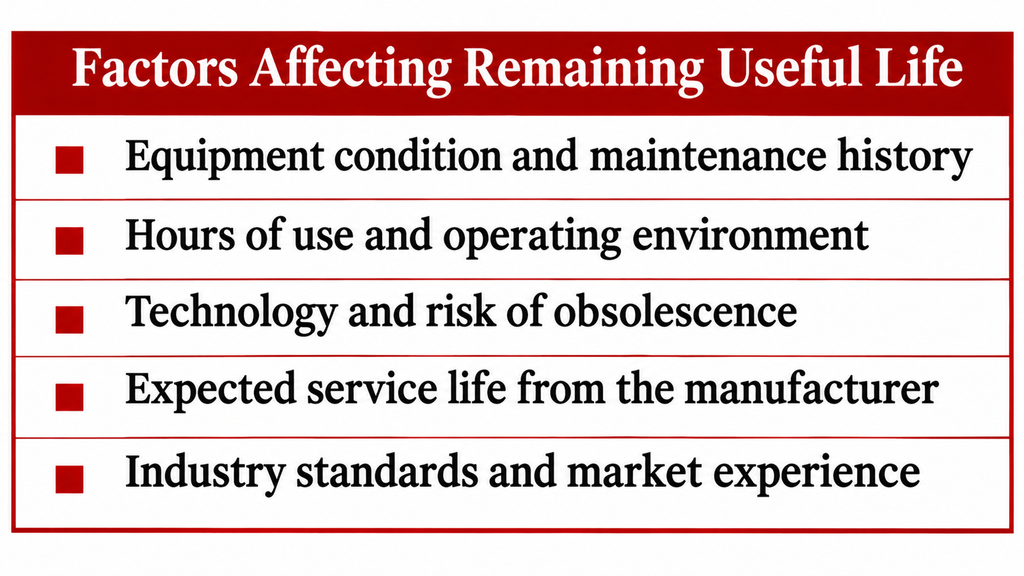
These factors help appraisers determine whether equipment can continue providing economic benefits to its owner.
Remaining Useful Life and Equipment Depreciation
Remaining useful life plays an important role in understanding equipment depreciation. As machinery ages, its physical condition, functionality, and market demand may change.
However, equipment does not always lose value at a consistent rate. A well-maintained industrial machine may retain significant utility, while newer equipment with outdated technology may experience faster depreciation.
Appraisers consider remaining service life alongside physical deterioration, functional obsolescence, and economic conditions when developing appropriate valuation conclusions.
Why Remaining Useful Life Matters
An asset’s expected service life can influence several important business decisions, including financing, financial reporting, and asset planning.
For lenders, an estimate of an asset’s remaining service life may provide useful information when evaluating machinery offered as collateral.
For business owners, understanding equipment longevity can support maintenance budgets, replacement schedules, and future capital expenditures.
In financial reporting, useful life estimates may also influence depreciation schedules and the allocation of equipment costs over time.
However, accounting useful life and appraisal-based remaining useful life may differ because they serve different purposes.
Remaining Useful Life in Manufacturing Equipment
Manufacturing facilities often rely on specialized machinery that operates for many years.
Equipment such as industrial presses, CNC machines, conveyor systems, and packaging lines may remain productive beyond their original estimated service periods.
For example, a manufacturing company may operate a fifteen-year-old CNC machine that continues meeting production requirements. If the machine has received consistent maintenance and remains economically competitive, it may still have meaningful remaining useful life.
Conversely, machinery with limited replacement parts, excessive repair costs, or outdated capabilities may have a shorter estimated service life.
This demonstrates why equipment age alone is not sufficient to determine its remaining usefulness.
The Importance of a Professional Appraisal
Estimating remaining useful life requires a review of the asset’s condition, use, maintenance, and current market factors.
A professional machinery and equipment appraiser evaluates these characteristics alongside relevant industry information and market evidence.
Depending on the assignment, the appraiser may also consider operating hours, equipment specifications, repair history, and technological developments.
The resulting estimate can help support valuation conclusions for financing, business transactions, financial reporting, and other intended uses.
For additional information about recognized professional appraisal standards, visit The Appraisal Foundation.
Businesses seeking professional equipment valuations can explore TMX Equipment Appraisal Services.
Understanding Asset Longevity
Understanding equipment longevity provides valuable insight into how long machinery can continue supporting business operations.
While equipment age is an important consideration, its condition, maintenance, technological relevance, and economic usefulness also influence its expected service life.
Understanding these factors helps lenders and business owners make informed decisions about equipment financing, replacement planning, and asset management.
TMX Equipment Appraisal Group provides professional machinery and equipment appraisal services nationwide, helping businesses and financial institutions understand the value of their tangible assets.
Learn more about our machinery and equipment appraisal services and how an independent valuation can support your business needs.
