
To prepare for a machinery appraisal, business owners often ask one of the first and most important questions: “What do I need to have ready?” The answer is simple: a little preparation can make the inspection more efficient, reduce follow-up questions, and help ensure the appraiser accurately identifies and values your assets.
Whether your appraisal is being completed for financing, an SBA loan, litigation, insurance, financial reporting, estate planning, or a business acquisition, taking time to prepare for a machinery appraisal benefits everyone involved.
This guide explains exactly what experienced machinery and equipment appraisers look for during an onsite inspection and how you can make the process as smooth as possible.
Why It Pays to Prepare for a Machinery Appraisal
A machinery appraisal is much more than walking through a facility and taking photographs. The appraiser’s responsibility is to identify each asset, document its characteristics, assess observable condition, verify identifying information, and collect enough market data to develop a credible opinion of value.
When you prepare for a machinery appraisal in advance, the inspection generally becomes:
- Faster and more organized
- More accurate
- Less disruptive to your operations
- Easier to document for lenders, accountants, attorneys, and auditors
Good preparation also minimizes the need for follow-up requests after the inspection is complete.
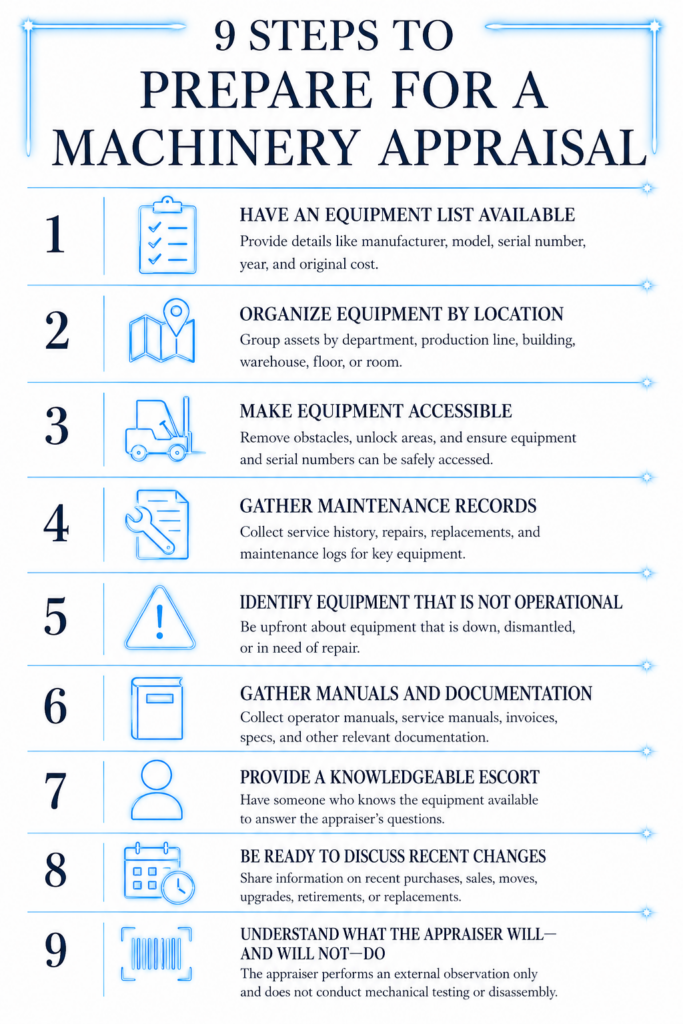
1. Have an Equipment List Available
The most helpful item you can provide is a current equipment list.
Even if it isn’t perfect, it gives the appraiser a starting point.
Helpful information includes:
- Manufacturer
- Model number
- Serial number
- Year manufactured (if known)
- Asset description
- Original cost
- Acquisition date
- Internal asset tag
Don’t worry if some information is missing. A qualified appraiser can often fill in many of the gaps during the inspection.
2. Organize Equipment by Location
If your facility contains hundreds of assets, organize them by:
- Department
- Production line
- Building
- Warehouse
- Floor
- Room
This significantly reduces inspection time and helps ensure no major assets are overlooked.
How to Prepare for a Machinery Appraisal When Equipment Is Stored Offsite
Many businesses have equipment located at:
- Storage yards
- Remote warehouses
- Job sites
- Customer facilities
- Third-party storage
Before the inspection, prepare a list of these locations and determine whether those assets need to be inspected or documented separately.
Knowing this beforehand helps establish the proper scope of work.
3. Make Equipment Accessible
One of the biggest delays during an inspection occurs when equipment cannot be reached.
If possible:
- Move pallets blocking machinery.
- Unlock fenced areas.
- Open electrical rooms if equipment is located inside.
- Ensure forklifts or lifts are available if elevated assets need to be viewed.
- Remove unnecessary obstacles around large equipment.
The appraiser is performing an external observation and needs to view identifying information such as nameplates and serial numbers whenever possible.
4. Gather Maintenance Records
While maintenance records are not always required, they can provide valuable context.
Useful records include:
- Service history
- Major repairs
- Component replacements
- Engine rebuilds
- Software upgrades
- Preventive maintenance logs
These documents may help explain the current operating condition of specialized equipment.
5. Identify Equipment That Is Not Operational
Be upfront about equipment that:
- Is dismantled
- Requires repair
- Has been partially cannibalized
- Is awaiting installation
- Has electrical or mechanical issues
Appraisers appreciate transparency. Knowing an asset’s status helps avoid unnecessary assumptions during the valuation process.
Prepare for a Machinery Appraisal by Gathering Manuals and Documentation
If available, collect:
- Operator manuals
- Service manuals
- Original invoices
- Build sheets
- Installation documentation
- Manufacturer specifications
This information is especially useful for highly specialized manufacturing equipment, laboratory instruments, CNC machinery, medical equipment, and custom-built systems.
6. Provide a Knowledgeable Escort
Assign someone who knows the equipment.
This individual can answer questions such as:
- When was it purchased?
- Has it been upgraded?
- Is it still in production?
- Does it currently operate?
- Was it custom-built?
- Are any components missing?
Having someone available to answer these questions often eliminates hours of follow-up research.
7. Be Ready to Discuss Recent Changes
Before the inspection, make a note of any equipment that has recently:
- Been purchased
- Been sold
- Been relocated
- Been retired
- Been upgraded
- Been replaced
Current information helps ensure the appraisal accurately reflects the assets as of the effective valuation date.
8. Make Serial Numbers Visible Whenever Possible
Serial numbers are critical for properly identifying machinery.
If they are hidden behind:
- Safety guards
- Pallets
- Storage racks
- Dust buildup
- Protective covers
Consider making them accessible before the inspection if it can be done safely.
This saves time and improves documentation.
9. Understand What the Appraiser Will and Will Not Do
Many clients assume the inspection is a mechanical evaluation.
It is not.
A professional machinery appraisal generally involves an external observation of the equipment’s observable condition. The appraiser documents identifying characteristics, photographs assets, verifies available information, and researches the marketplace to develop an opinion of value.
Unless specifically agreed upon in the scope of work, machinery appraisers typically do not:
- Perform mechanical testing
- Disassemble equipment
- Conduct engineering inspections
- Certify operational performance
- Verify regulatory compliance
Understanding this distinction helps establish realistic expectations before the inspection begins.
Make Your Machinery Appraisal Inspection Efficient
The best inspections are well organized before the appraiser arrives.
By taking a little time to prepare for a machinery appraisal, you’ll help streamline the inspection, reduce follow-up questions, and provide the appraiser with the information needed to produce a well-supported valuation.
Whether the appraisal is being completed for financing, litigation, financial reporting, insurance, estate planning, or a business transaction, preparation contributes to a more efficient process and a more complete appraisal report.
If your organization is preparing for an upcoming machinery appraisal, working with an experienced, ASA-accredited machinery Appraiser like the TMX Group can help ensure the assignment is completed in accordance with recognized professional standards and accepted valuation methodologies.
