
A Bank Equipment Appraisal helps a lender understand the value of machinery pledged as collateral. However, not every equipment valuation will satisfy a bank’s requirements.
Banks need more than a list of estimated values. They need a credible report that supports a lending decision. The appraisal should identify the assets, explain the valuation methods, and disclose important assumptions.
The appraiser’s qualifications also matter. Many lenders prefer an appraiser with a recognized professional designation. The report should also comply with applicable professional appraisal standards.
What Is a Bank Equipment Appraisal?
A Bank Equipment Appraisal is an independent opinion of value prepared for a lending purpose. It helps the bank evaluate the equipment supporting a proposed or existing loan.
The appraisal may include Fair Market Value, Orderly Liquidation Value, or both. Some lenders may also request Forced Liquidation Value or Net Orderly Liquidation Value.
Each value premise answers a different question. Fair Market Value reflects a transaction between willing parties. Orderly Liquidation Value assumes the owner must sell within a reasonable period.
The bank should identify the required value premise before the assignment begins. Using the wrong premise can make an otherwise credible appraisal unsuitable for the loan.
The Appraiser Must Be Qualified
Banks often review the appraiser’s education, experience, and professional designations. The appraiser should have experience with the type of machinery being valued.
A general real estate appraiser may not be qualified to value industrial equipment. Machinery appraisal requires knowledge of equipment markets, depreciation, condition, installation, and removal costs.
An Accredited Senior Appraiser, or ASA, has completed specialized education and experience requirements. The designation also requires adherence to professional standards and ethical rules.
Some banks maintain approved-appraiser lists. Others review qualifications for each assignment. A résumé and professional history are commonly included within the report.
Professional Standards Are Important
A credible Bank Equipment Appraisal should comply with the Uniform Standards of Professional Appraisal Practice, commonly known as USPAP. These standards establish requirements for ethics, competency, scope of work, and reporting.
USPAP does not determine the value of the equipment. Instead, it guides the development and communication of the assignment.
The report should identify the client and intended users. It should also state the intended use of the appraisal. For lending assignments, the intended use is usually collateral evaluation or credit underwriting.
The appraiser must remain independent. Compensation cannot depend on reaching a requested value or supporting a loan approval.
The Equipment Must Be Clearly Identified
The appraisal should contain enough information to identify the subject assets. This often includes the manufacturer, model, year, serial number, and equipment description.
Hours, mileage, capacity, accessories, and major options may also be important. These details allow the appraiser to select appropriate market comparables.
Serial numbers can help confirm the identity and age of an asset. They may also distinguish similar machines located at the same facility.
Incomplete information creates uncertainty. If information is unavailable, the report should disclose that limitation. The appraiser may also need to use an extraordinary assumption.
A bank should be able to compare the appraisal schedule with its collateral documents. Major differences should be investigated before the report is accepted.
The Correct Values Must Be Reported in a Bank Equipment Appraisal
Banks commonly request both Fair Market Value and Orderly Liquidation Value. The values serve different purposes within the credit review.
Fair Market Value may help the lender understand the asset’s value in a normal market. Orderly Liquidation Value provides a more conservative recovery estimate.
Some assignments require values on an installed basis. Others assume the equipment will be sold “as-is, where-is.” The report must clearly explain the selected premise.
The distinction is especially important for large production equipment. A machine may have significant value while installed and operating. Its value could decline after shutdown, disassembly, or removal.
The bank may also request Net Orderly Liquidation Value. This value deducts applicable expenses from the expected gross sale proceeds. Expenses may include commissions, marketing, rigging, transportation, storage, and professional fees.
Valuation Methods Must Be Supported
A Bank Equipment Appraisal should explain how the appraiser arrived at each valuation conclusion. Simply applying a standard percentage to the original cost is rarely sufficient.
The Sales Comparison Approach uses market evidence from similar equipment. The appraiser may consider dealer listings, auction results, private sales, and other available data.
Adjustments may be needed for age, condition, hours, mileage, capacity, options, or location. The report should explain significant adjustments.
The Cost Approach begins with the current cost of a comparable new asset. The appraiser then considers physical, functional, and economic depreciation.
This approach may be useful for custom machinery or equipment with limited market data. It can also support the value of certain ancillary assets.
The Income Approach is less common for individual machinery. Equipment usually does not generate an independent income stream. The report should explain why an approach was used or excluded.
Current Market Evidence Matters
Equipment markets change over time. Supply, demand, interest rates, commodity prices, and industry conditions can affect value.
A reliable appraisal should reflect the market as of the effective date. Older sales may still be useful, but they may require adjustment.
Current asking prices can provide relevant market evidence. However, asking prices do not always represent completed transactions. The appraiser should consider the reliability of each source.
The report should contain enough market support to make the analysis understandable. Confidential sources may be described without revealing protected information.
Inspection and Condition Should Be Addressed in a Bank Equipment Appraisal
An on-site appraisal allows the appraiser to observe the equipment and record identifying information. It can also help document apparent condition and configuration.
However, banks sometimes accept desktop appraisals. A desktop assignment relies on photographs, asset schedules, maintenance information, and other client-provided data.
The inspection format should match the bank’s risk tolerance and the assignment’s circumstances. Higher-value or specialized machinery may justify an on-site inspection.
An equipment inspection is generally visual and external. The appraiser does not normally perform mechanical testing unless that service is specifically arranged.
The report should disclose how the condition was determined. Any condition assumptions should also be clearly stated.
Assumptions and Limitations Must Be Disclosed
Every appraisal includes assumptions and limiting conditions. These provisions help users understand the boundaries of the analysis.
An extraordinary assumption may be necessary when an important fact is uncertain. For example, the appraiser may assume that equipment is operational based on information supplied by the borrower.
The report should also disclose missing serial numbers, unavailable maintenance records, or limited photographs. These issues do not always prevent an appraisal. However, they may affect the report’s reliability.
Transparency is essential. Banks need to understand what was verified and what was assumed.
The Bank Equipment Appraisal Report Must Be Clear and Complete
A bank should be able to follow the appraisal from the asset description to the final value conclusion. The report should be organized and internally consistent.
The value summary should reconcile with the detailed equipment schedule. Mathematical errors, missing assets, and inconsistent totals can create concerns.
The report should include the effective date, report date, value definitions, scope of work, methodology, assumptions, and appraiser certification. It should also contain the appraiser’s signature and qualifications.
Photographs can help the bank understand the collateral. They may also support the reported condition and equipment identification.
A strong report explains the reasoning behind the values. It does not rely only on unsupported conclusions.
Meeting the Bank’s Appraisal Requirement
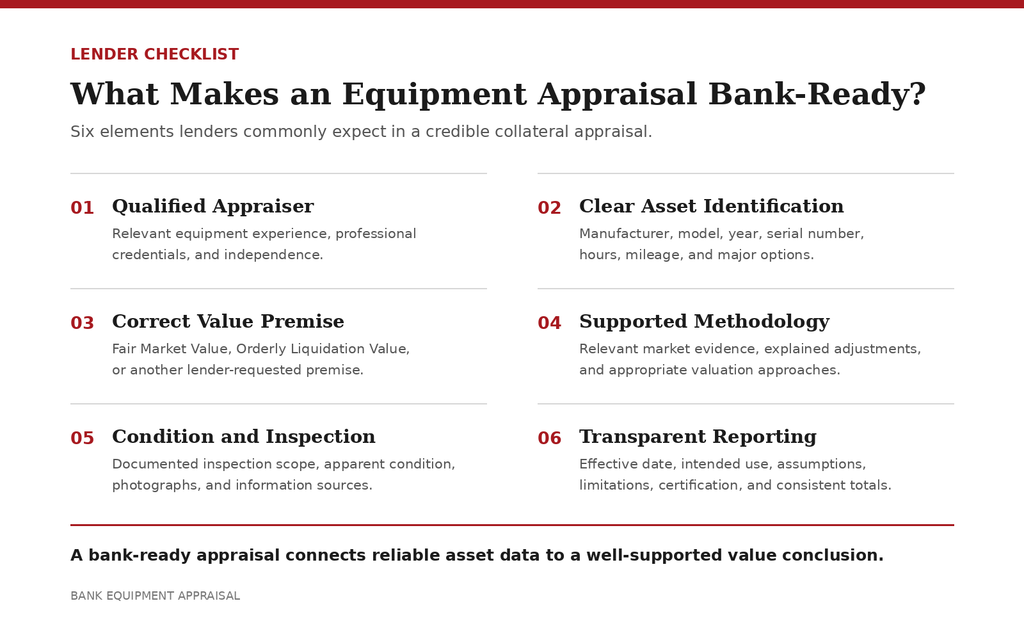
A credible Bank Equipment Appraisal gives the lender an independent basis for evaluating collateral. It can support underwriting, loan monitoring, refinancing, and decisions on troubled assets.
The report should use the correct value premise and effective date. It should clearly identify the assets and disclose important limitations. Market evidence and valuation methods should support the conclusions.
Banks may have different appraisal policies. The lender’s requirements should be confirmed before work begins.
A qualified machinery and equipment appraiser can help define the proper scope of work. This reduces delays and provides the bank with a report designed for its intended lending purpose.
